
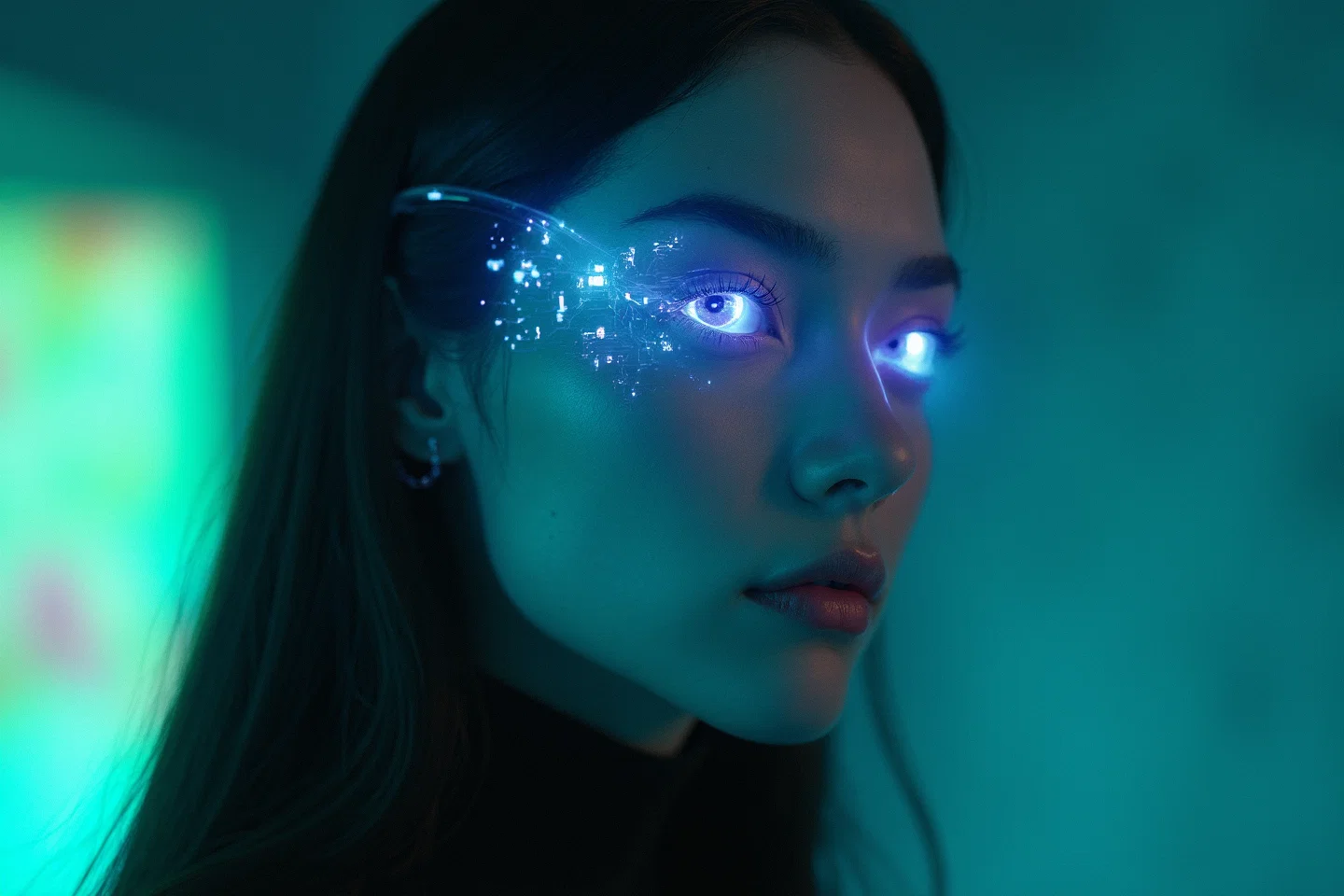
What if reliving a memory became as simple as playing a video? What if the boundary between reality and fiction blurred in favour of total immersion? This is the unsettling experience offered by the Nubbin, a fictional device imagined in Season 7 of the cult series Black Mirror, created by TCKR Systems within the show’s universe.
Appearing in standout episodes such as “Hotel Reverie”, “Eulogy”, and “USS Callister: Into Infinity”, this small object—mixing augmented memory and virtual reality raises profound questions about the limits of identity, the power of memory, and the seduction of technological illusion.
In this article, we break down the role of the Nubbin in the series, its symbolic meaning, and what it reveals about our increasingly ambiguous relationship with technology.
A Buzz Engineered to Launch Black Mirror Season 7
The Nubbin didn’t just make an impression on screen: it sparked a real buzz across social media. Presented as a real technology through an ultra-realistic promotional website, the device was shared by countless tech influencers and content creators on TikTok, Instagram, and X (formerly Twitter). The goal? Blur the lines between fiction and reality, and heighten curiosity around Season 7 of Black Mirror.
This immersive strategy worked perfectly: many began wondering whether the Nubbin actually existed. A brilliant communication operation, true to the DNA of the series, which uses fiction to better question our relationship with today’s technologies.
An Immersive Technology at the Heart of Black Mirror’s Narrative
Introduced from the earliest episodes of Season 7, the Nubbin quickly becomes a narrative thread throughout the series. Developed by TCKR Systems (the same company behind the simulated reality in San Junipero), this small device allows users to revisit memories, experience alternate scenarios, or immerse themselves in hyper-realistic fictional worlds.
In “Eulogy”, the Nubbin is used to reignite emotional memories. In “Hotel Reverie”, it becomes a tool for exploring the unconscious memory between dreams, nostalgia, and illusion. Finally, in “USS Callister: Into Infinity”, the Nubbin allows full immersion in a personalised space opera, where each user becomes the hero of a virtual world shaped by their desires.
More than a simple gadget, the Nubbin acts as a digital extension of human consciousness an interface between reality, memory, and fiction.
One of the show’s most ingenious moves lies in its ambiguous marketing strategy. The promotional website for the Nubbin, designed as if it were a genuine tech product, invites users to “revisit their memories”, “embody heroes from classic films”, or “explore infinite galaxies”.
The experience is so convincing that many viewers wondered whether the Nubbin truly existed—proof of how skilfully Black Mirror plays with the boundary between the real and the imaginary.
Tech influencers were even involved in the promotion, further blurring the lines between innovation and fiction. A clever piece of viral marketing that leaves us questioning: are we really that far from such a device?
When Technology Shapes Our Illusions
The Nubbin encapsulates several technological fantasies deeply rooted in our era. First, it reflects the cult of memory, this desire to relive the past to better analyse it, reinterpret it, or sometimes idealise it.
This need for control also expresses itself through immersive escape: the possibility of surrendering to a perfectly mastered virtual universe, even if it means escaping a reality deemed too harsh or disappointing.
Finally, the Nubbin pushes digital personalisation to the extreme, creating worlds entirely shaped by our memories, emotions, and personal stories. A technology which, while fascinating, questions our relationship with identity, truth, and the very nature of reality.
As often in Black Mirror, technology is neither good nor bad in itself: it becomes a mirror of our vulnerabilities. The Nubbin fascinates, but also worries. What consequences might arise for psychological balance if every memory can be relived? If the lines between fiction and truth become blurred? If our digital identity overtakes our lived reality?
Even though the Nubbin remains a fictional device, its concept is not far removed from current research in neuroscience, virtual reality, or neural recording. Projects like those of Neuralink (Elon Musk) or advances in generative AI show that artificial memory and cognitive reconstruction are no longer purely science fiction.
And this is precisely the essence of Black Mirror: presenting an “impossible” technology that, deep down, already seems within reach.
With the Nubbin, Black Mirror reminds us just how thin the line between fiction and reality can be. This small device, although fictional, reflects very contemporary desires: to relive memories, escape into virtual worlds, and maintain control over one’s own story.
The Nubbin may not exist today, but the idea behind it already resonates within the projects of many tech companies. Perhaps it is only fiction… or an idea ahead of its time.
And what if the Nubbin were only the beginning?
Want to stay connected to the most fascinating technologies of the moment — real or fictional?
For more updates, follow us on LinkedIn and stay informed via our IZEMX blog.